About Ivan Fritzen
My work in music has developed across several connected areas: violin performance, teaching, academic research, and curatorial practice.
Rather than following a single path, I have spent my professional life moving between playing, teaching, studying music, researching its histories, and thinking about how repertoire and interpretation acquire meaning. Over time, those experiences have become different parts of the same musical perspective.
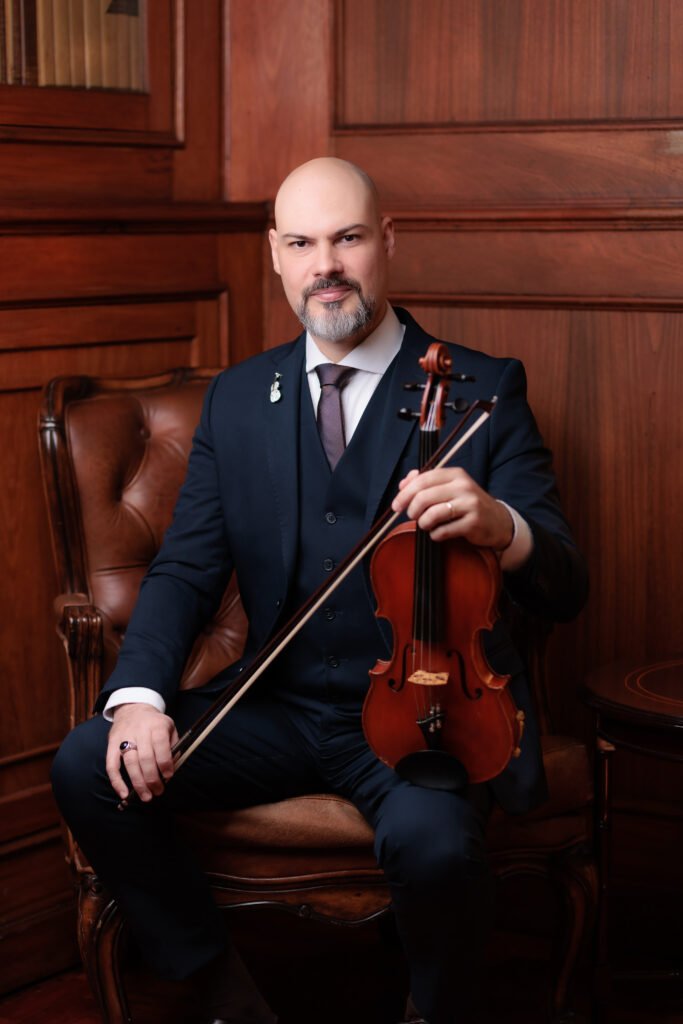
A Life in Music
I began my formal training as a violinist, but my curiosity about music soon extended beyond performance itself.
Questions about style, interpretation, musical cultures, recordings, and the history behind repertoire eventually led me to graduate study in musicology and ethnomusicology. At the same time, I continued performing professionally and building a teaching practice.
Moving between these different environments changed the way I understood musicianship. Performance taught me about immediacy, preparation, sound, and communication. Research taught me to question assumptions and look more closely at context. Teaching required me to translate all of that into something useful for another person.
Today, I see these not as separate careers, but as different ways of engaging seriously with music.
What Teaching Adults Has Taught Me
Working with adult violin students for more than 16 years has profoundly shaped my understanding of musical learning.
Adults rarely arrive at the instrument as blank slates. They bring decades of listening, cultural references, professional experience, habits of thought, expectations, doubts, and often a very clear sense of why music matters to them. That changes the nature of teaching.
An adult may understand an idea intellectually before the body can execute it. A returning player may carry both useful experience and habits that need to be reconsidered. An amateur musician may have no professional ambitions and yet be deeply interested in artistic questions that deserve serious attention.
These experiences have taught me to value patience without passivity, rigor without unnecessary pressure, and progress without reducing musical development to a fixed timetable.
They have also reinforced something I have believed for a long time: the seriousness of a musical education should not depend on whether someone intends to become a professional musician.
Beyond the Violin
Much of what has shaped me musically has happened outside the traditional lesson room.
Performance
My work as a performer has never been limited to European concert music. Alongside classical training, I have worked with Hungarian repertoire, Romani music from Central and Eastern Europe, intercultural projects, and studio recording.
These different musical contexts have shaped the way I understand performance: not simply as the execution of a score, but as an encounter with style, context, listening, and communication.
Research
My research experience includes ethnomusicological fieldwork with elderly native women singers in Amaicha del Valle, Argentina, examining relationships between voice, body, territory, memory, and sense of place.
This work resulted in the book Os cantos das copleras em Amaicha del Valle [The chants of the copleras in Amaicha del Valle], published in 2024.
Curatorial Work
I develop the Baxtale Archive, an independent, multilingual, and interdisciplinary research archive devoted to Romani histories, cultures, and representations through books, sound recordings, and audiovisual materials.
The project combines collection building, cataloguing, documentation, and contextual research, bringing together materials from different periods and countries.
Education & Background
My formal training combines violin performance with advanced academic study in ethnomusicology.
Bachelor of Music | Violin
2008-2011 | Federal University of Rio Grande do Sul (UFRGS), Porto Alegre, Brazil
Master’s Degree in Music | Musicology/Ethnomusicology
2014-2016 | Federal University of Rio Grande do Sul, Porto Alegre, Brazil
Start Your Study
If you are looking for a teacher whose approach to the violin is informed by a broader life in music, you are welcome to tell me a little about your own musical background and where you would like your study to go.